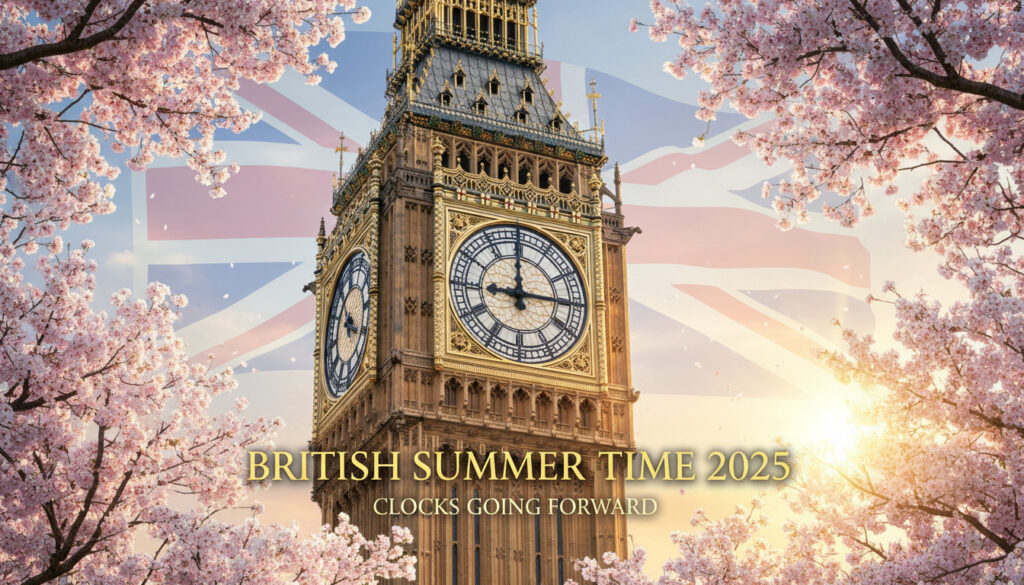
When Do Clocks Go Forward – 2025 UK Dates and Guide
British Summer Time begins on 30 March 2025, when clocks across the United Kingdom advance by one hour at 1:00am GMT. This annual shift to British Summer Time (BST) marks the start of longer evenings and shorter mornings, affecting everything from sleep patterns to energy consumption nationwide.
While some welcome the extra daylight after work, others dread the lost hour of sleep. The transition follows a pattern established over a century ago, yet debates continue about whether this twice-yearly ritual still serves modern society. Accurate timing remains essential in daily life, comparable to precise measurements in cooking 1/4 Cup in mL – Exact US and Metric Guide.
This guide provides exact dates, historical context, and practical preparation tips for the 2025 clock changes.
When Do the Clocks Go Forward in 2025?
2025 Forward Date
Last Sunday in March (March 30)
Change Time
1:00 AM GMT to 2:00 AM BST
Duration
Until October 26, 2025
Global Note
UK aligns with EU dates
Key Facts About the Spring Forward
- Clocks advance on the last Sunday of March every year
- The change occurs instantaneously at 1:00am Greenwich Mean Time
- British Summer Time lasts exactly seven months until late October
- The shift provides approximately 180 additional evening daylight hours annually
- 2026 will see clocks move forward on March 29, while 2027 changes on March 28
- Sunday morning minimizes disruption to schools and businesses
| Detail | Specification |
|---|---|
| 2025 Forward Date | 30 March 2025 |
| Exact Time | 01:00 GMT → 02:00 BST |
| Time Zone Shift | UTC+00:00 to UTC+01:00 |
| 2025 Back Date | 26 October 2025 |
| Duration of BST | Approx. 7 months |
| 2026 Forward Date | 29 March 2026 |
| 2027 Forward Date | 28 March 2027 |
| Legal Basis | Summer Time Act 1916 |
| EU Alignment | Last Sundays of March/October |
For official date confirmation, visit the UK Government’s clock change portal. Additional 2025-specific details are available via Time Out London.
Why Do We Put the Clocks Forward?
The Original Purpose
William Willett first proposed daylight saving in 1907 to prevent wasted morning light and extend usable evening hours. The concept aimed to reduce artificial lighting costs and improve public health through outdoor recreation time. Parliament eventually adopted the measure during World War I under the Summer Time Act 1916.
Originally, the primary justification centered on energy conservation. Households and businesses would require less coal-generated electricity during longer evenings. Modern analysis, however, questions these savings, as increased heating and cooling demands often offset reduced lighting needs.
How the Change Works
The mechanics remain straightforward: digital devices connected to network time protocols adjust automatically at the designated moment. Mechanical clocks and watches require manual advancement by sixty minutes. The shift effectively transfers one hour of morning daylight to the evening, giving workers extended afternoon and evening illumination.
British Summer Time provides one extra hour of evening daylight during summer months, extending usable outdoor time for recreation and commuting. This remains the primary practical advantage cited by supporters of the system.
The RAC guidance on clock changes provides additional technical details on time adjustments.
When Do the Clocks Go Back?
The return to Greenwich Mean Time occurs on 26 October 2025 at 2:00am BST, when clocks revert to 1:00am GMT. This marks the end of British Summer Time and the beginning of shorter, darker evenings.
Autumn Sunset Times
Following the October change, sunset arrives significantly earlier across the United Kingdom. London will see darkness fall at 4:44pm, Edinburgh at 4:45pm, Cardiff at 4:56pm, and Belfast at 5:00pm. These shortened afternoons last until the following March.
Future year dates are documented by Greenwich Mean Time.
Which Countries Observe Daylight Saving Time?
The United Kingdom aligns with European Union member states, observing coordinated changes on the final Sundays of March and October. Germany shifts simultaneously at 2:00am Central European Time, becoming 3:00am Central European Summer Time.
Global Variations
Approximately seventy nations worldwide adjust their clocks seasonally. The United States and Canada begin daylight saving on the second Sunday in March, ending on the first Sunday in November. Australia and New Zealand operate on entirely different schedules due to Southern Hemisphere seasons.
The European Parliament voted in 2023 to abolish mandatory daylight saving time by 2026, but implementation remains stalled pending consensus on whether to adopt permanent summer or winter time. The United Kingdom, now outside the EU, maintains independent authority over time changes and currently follows the harmonized dates.
The spring forward transition correlates with increased risks of heart attacks, traffic accidents, and workplace injuries due to acute sleep deprivation. The autumn return, conversely, provides a temporary mood boost but signals the beginning of seasonal affective disorder risks for many. Du kan finne mer informasjon om når klokken stilles i Storbritannia på Når skal klokka stilles.
Global daylight saving policies are detailed by the Wikipedia entry on British Summer Time and BBC Explainers.
How Has British Summer Time Evolved Over the Years?
- 1916: The United Kingdom first implements daylight saving time on May 21, moving clocks forward one hour under the Summer Time Act, following Germany’s earlier adoption.
- 1940-1945: Double Summer Time operates during World War II, advancing clocks two hours ahead of GMT.
- 1972-1995: Dates vary annually, changing around Easter Sunday and late October rather than fixed calendar positions.
- 1996: The UK aligns with European Union harmonized dates, settling on the last Sundays of March and October.
- 2002: EU Directive 2000/84/EC formally codifies the current dates, retained in UK law post-Brexit.
- 2023: The European Parliament votes to eliminate mandatory clock changes by 2026, though member states remain divided on permanent time selection.
- 2025: British Summer Time continues with the March 30 forward change and October 26 return.
What Is Certain About Future Clock Changes?
| Established Information | Information That Remains Unclear |
|---|---|
| 2025 dates are fixed by law: March 30 forward, October 26 back | Whether the EU will actually abolish daylight saving time by 2026 |
| The pattern of last Sunday in March/October remains legally binding | Which permanent time zone the EU would select if abolition proceeds |
| The UK government maintains current policy with no active abolition plans | Whether a future UK government might follow EU abolition or choose permanent BST/GMT |
| 2024 YouGov polling shows 46% support keeping changes, 42% oppose | Whether health or energy arguments will eventually shift political consensus |
What Are the Real Impacts of Changing the Clocks?
The biannual adjustment affects biological rhythms significantly. The spring forward reduces sleep by exactly sixty minutes, triggering measurable increases in cardiovascular events and road traffic incidents during the subsequent week. Conversely, the autumn return provides a temporary circadian reprieve, though earlier darkness contributes to seasonal mood disorders.
Energy implications remain contested. While early twentieth-century calculations suggested substantial coal savings, contemporary studies indicate minimal net benefits. Modern behavioral patterns, including increased air conditioning and electronic device usage, largely neutralize lighting reductions.
Technology has simplified compliance for many. Network-connected smartphones, computers, and smart home systems adjust automatically via atomic clock synchronization. However, vehicle clocks, wall appliances, and mechanical timepieces demand manual intervention to prevent scheduling errors.
What Do Experts Say About Daylight Saving?
“Daylight saving disrupts sleep patterns significantly, with the spring transition showing measurable spikes in heart attacks and workplace accidents.”
Sleep Council
“No significant energy savings have been demonstrated in modern UK consumption patterns.”
UK Government Report
What Should You Remember About the 2025 Clock Change?
Mark Sunday 30 March 2025 at 1:00am for the forward change to British Summer Time, and Sunday 26 October 2025 at 2:00am for the return to Greenwich Mean Time. While most digital devices update automatically, verify manual clocks and appliances to avoid disruption. For official government services and financial management around these dates, ensure secure access through Help to Save Sign In – Secure GOV.UK Login Guide.
Frequently Asked Questions
Does the clock change affect my devices?
Smartphones, computers, and tablets connected to network time protocols adjust automatically. However, manual clocks, vehicle dashboards, and some household appliances require manual updating.
What happens if I forget to change my clock?
You may arrive one hour late for appointments on the Sunday morning following the spring forward. Digital calendars usually adjust automatically, but double-check any manually scheduled events.
Do smartphones update automatically for British Summer Time?
Yes, iOS and Android devices connected to cellular or Wi-Fi networks receive automatic time updates based on your location settings, provided automatic timezone detection remains enabled.
Will the UK ever stop changing the clocks?
Currently, no. While 42% of respondents favored abolition in a 2024 YouGov poll, the government maintains the status quo with no active legislation to end the practice.
How dark will evenings get after the October change?
Sunset times drop to approximately 4:44pm in London and 4:45pm in Edinburgh on October 26, 2025, with darkness falling earlier as winter progresses.
Who was William Willett and why does he matter?
William Willett was a builder who campaigned for daylight saving from 1907 until his death in 1915, proposing gradual 80-minute advances. His work led to the 1916 Summer Time Act.
Why do clocks change on a Sunday morning?
Sunday minimizes disruption to transportation schedules, financial markets, and school operations, allowing businesses and institutions to adjust during a typically lower-activity period.
More related posts
 Bank of Scotland Login – Personal & Business Guide
 Clifford the Big Red Dog – Complete Franchise Guide
 Under the Banner of Heaven – True Story, Cast and Complete Guide
 How to Make Slime Without Activator – 4 Safe Recipes
 TUI Flights Cancelled Today – Gatwick Manchester UK Status
 Old Yahoo Mail Login – How to Access Classic Interface 2026
 Pete Wild Fleetwood Sacked – Why He Was Axed and What’s Next
 Man Finds Hen Party Doorstep – Liverpool Booking.com Error
