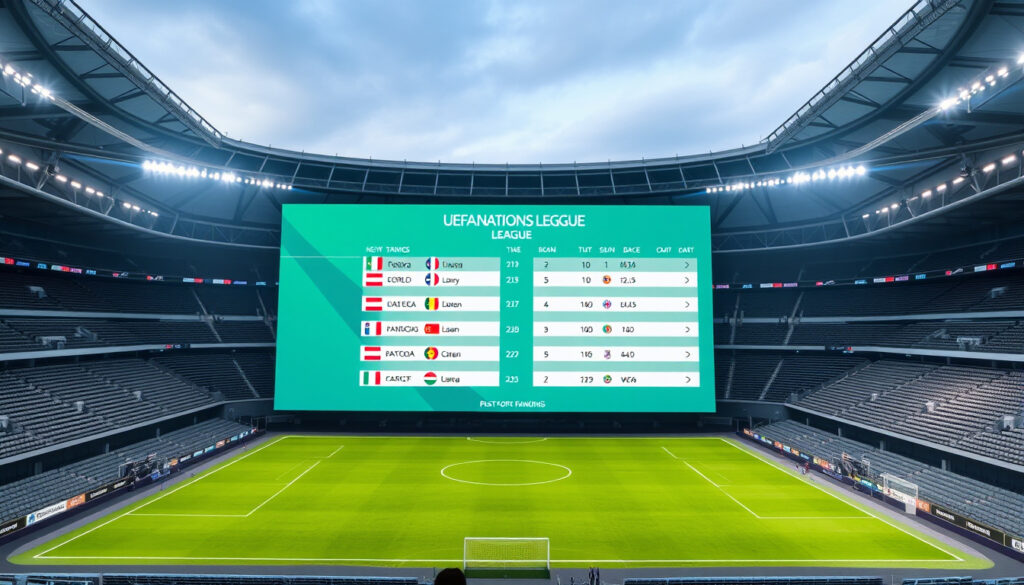
UEFA Nation League Standing – Live Table & Full Guide
The UEFA Nations League has become a central fixture in European football, offering competitive matches that replace most international friendlies. For fans tracking the 2024–25 season and looking ahead to the 2026–27 edition, understanding the standings, group structure, and promotion-relegation mechanics is essential. This article provides a clear, fact-based overview of the current league tables, the competition’s format, historical winners, and what lies ahead.
What Are the Current UEFA Nations League Standings?
Top team in each group
Live table
8 teams from League A
UEFA official
September 2026
UEFA calendar
Spain (2023 winners)
UEFA history
The official UEFA standings page is the most authoritative source for live group tables. According to UEFA, the page shows the complete table of latest group stage standings, updated instantly after each game. As of the most recent snapshots, most teams in the 2026–27 League A groups have zero matches played, meaning the tables reflect the pre-competition group structure rather than finished results.
- The Nations League replaces most international friendlies with competitive matches.
- Standings determine promotion, relegation, and qualification pathways to major tournaments.
- League A group winners advance to the knockout phase (quarterfinals introduced in 2024–25).
- Tiebreakers: head-to-head points, goal difference, goals scored, away goals.
- UEFA uses Nations League rankings as a secondary tiebreaker for Euro and World Cup qualifying.
| Season | Champion | Runner-up | Top Scorer | Format Note |
|---|---|---|---|---|
| 2018–19 | Portugal | Netherlands | Cristiano Ronaldo (5 goals) | 4-group finals |
| 2020–21 | France | Spain | Erling Haaland (6 goals) | COVID-19 schedule shift |
| 2022–23 | Spain | Croatia | Erling Haaland / Aleksandar Mitrović (6 goals) | New finals format |
| 2024–25 | TBD (June 2025) | TBD | TBD | Quarterfinals introduced |
For real-time updates, the UEFA Nations League standings – official live table remains the most reliable source. Secondary options include Sky Sports Nations League Table and ESPN UEFA Nations League Standings, both of which display group tables with points, goals, and form indicators.
How Do the Nations League Groups and Leagues Work?
The competition divides all 55 UEFA member associations into four leagues — A, B, C, and D — based on their ranking. League A contains the highest-ranked teams, while League D includes the lowest. Teams are split into groups within each league, playing home-and-away matches during the group stage.
Why Are There Different Leagues?
The league system ensures that teams face opponents of similar strength. This structure, as confirmed by UEFA’s official regulations, creates more competitive matches and gives smaller nations a realistic chance at promotion and qualification.
Promotion and Relegation Explained
UEFA’s official rules state that in League A, the top two teams in each group advance to the quarter-finals. The third-placed teams enter promotion/relegation play-offs, and the fourth-placed teams are automatically relegated to League B. In League B, group winners are promoted to League A, while fourth-placed teams drop to League C. League C group winners rise to League B, and the two lowest-ranked fourth-placed teams in League C are relegated to League D. League D group winners are promoted to League C.
Only League A teams compete for the Nations League trophy. Leagues B, C, and D compete for promotion within their tier, not for the overall championship.
Quarterfinals and Play-Off Schedule
The quarter-finals, League A/B play-offs, and League B/C play-offs are all scheduled for 25–30 March 2027, according to UEFA. The winners of the League A quarter-finals then proceed to the final tournament in June 2027.
Who Are the UEFA Nations League Winners and Finalists?
Past Champions
Portugal won the inaugural edition in 2018–19, defeating the Netherlands in the final. France claimed the second edition in 2020–21, a season affected by the COVID-19 pandemic. Spain won the third edition in 2022–23, beating Croatia in the final. The 2024–25 champion will be determined in June 2025, with the quarter-finals being a new addition to the format.
Top Scorers by Edition
Cristiano Ronaldo led the scoring in 2018–19 with five goals. Erling Haaland netted six goals in 2020–21, and shared the top-scorer honours with Aleksandar Mitrović (also six goals) in 2022–23. The leading marksman for the current season will be confirmed after the tournament concludes.
The 2024–25 season introduced quarter-finals for League A for the first time, adding a knockout round before the final four. This change increased the stakes for group-stage positioning.
How Do Nations League Standings Affect World Cup and Euro Qualification?
Nations League performance directly influences qualification pathways for both the UEFA European Championship and the FIFA World Cup. UEFA uses Nations League rankings as a secondary tiebreaker in qualifying groups. Additionally, the best-performing Nations League teams that do not qualify directly through the traditional group stage earn a spot in the play-offs.
For example, the Nations League ranking determines which teams receive a bye to the play-off semi-finals and which must start in the first round. This system gives smaller nations a realistic path to major tournaments, which was one of the primary motivations for creating the competition.
The exact play-off allocation for each qualifying cycle depends on UEFA’s regulations for that specific tournament. Fans should consult the official UEFA documents for each qualifying campaign to understand the precise impact.
What to Expect in the 2026–27 UEFA Nations League Season
The draw for the 2026–27 league phase was held in Brussels on 12 February. The League A groups are already set, featuring some of Europe’s top national teams. Group A1 includes France, Italy, Belgium, and Türkiye. Group A2 consists of Germany, Netherlands, Serbia, and Greece. Group A3 brings together Spain, Croatia, England, and Czechia. Group A4 contains Portugal, Denmark, Norway, and Wales.
As of the available standings data, most teams in these groups have not yet played a match, so the tables reflect the initial group layout rather than competitive results. Matches are expected to begin in September 2026.
- 2018 — UEFA Nations League launched (first season 2018–19)
- 2019 — Portugal wins inaugural edition
- 2020–21 — France wins second edition; schedule altered due to pandemic
- 2022–23 — Spain wins third edition; new final four format
- 2024–25 — Quarterfinals added for League A; current season running
- 2026–27 — Next full Nations League season begins
For a complete overview of the upcoming tournament, see the UEFA Nations League 2026/27 – All you need to know page.
What Is Known and What Remains Uncertain About the Nations League?
| Established Information | Information That Remains Unclear |
|---|---|
| Current group standings are updated in real-time on UEFA’s official site | Quarterfinal matchups for 2024–25 (group winners known, draw pending) |
| Promotion/relegation rules are published in UEFA regulations | Full groups for 2026–27 beyond League A (not all leagues confirmed at this stage) |
| Nations League ranking determines play-off spots for World Cup qualifying | Exact play-off format for the 2026 World Cup qualifying cycle |
What Is the Purpose of the UEFA Nations League?
The Nations League was introduced to reduce the number of meaningless international friendlies and provide competitive matches for all 55 UEFA member associations. The format ensures that teams face opponents of comparable strength, making results more meaningful for players, coaches, and fans.
For smaller nations, the competition offers a realistic path to promotion and, through the qualification play-off system, a chance to reach the European Championship or World Cup. The 2024–25 quarterfinal addition further increased the stakes for League A group winners by adding a knockout layer before the finals.
Standings relevance extends beyond the trophy: teams that win their League B, C, or D group earn promotion to a higher league, while last-place teams face relegation. Nations League performance also serves as a critical tiebreaker in UEFA European Championship and FIFA World Cup qualifying campaigns.
Where to Find Official UEFA Nations League Data and Live Tables
The most authoritative source is the official UEFA website, which hosts the live standings page and all competition regulations. UEFA describes its standings page as the complete table of latest group stage standings, updated instantly after every game. This page covers all four leagues and provides real-time group-stage data.
“The UEFA Nations League provides more competitive football for national teams, with promotion and relegation adding sporting stakes to every match.”
— UEFA Nations League Regulations
“The introduction of quarter-finals for League A in 2024–25 adds an extra layer of excitement and raises the stakes for group-stage performance.”
— UEFA official announcement
“Nations League rankings serve as a secondary tiebreaker in European Championship and World Cup qualifying, giving the competition added significance beyond its own trophy.”
— Wikipedia – UEFA Nations League
UEFA’s official documents, including the UEFA Nations League Regulations (PDF), provide the definitive rules. The Wikipedia – UEFA Nations League page offers a useful historical reference for past winners and format evolution.
Summary: Key Takeaways on UEFA Nations League Standings
The UEFA Nations League standings are the definitive measure of each team’s performance across the four leagues. League A groups determine the quarter-finalists and the eventual champion, while lower leagues determine promotion and relegation. The official UEFA standings page provides real-time updates, and the competition’s rules regarding tiebreakers, promotion, and qualification pathways are clearly documented in UEFA regulations.
Frequently Asked Questions
How are UEFA Nations League tiebreakers applied?
Tiebreakers in order: 1) Head-to-head points between tied teams, 2) Head-to-head goal difference, 3) Head-to-head goals scored, 4) Overall goal difference, 5) Overall goals scored, 6) Away goals in head-to-heads, 7) Fair play ranking, 8) UEFA coefficient.
Can a team win the Nations League without being in League A?
No. Only League A teams compete for the championship title. Leagues B, C, and D compete for promotion within their tier, not the overall trophy.
How does Nations League promotion and relegation work?
The last-placed team in each group is relegated to the lower league. Group winners from Leagues B, C, and D are promoted to the next higher league. League D winners are promoted to League C.
Does the Nations League affect FIFA rankings?
Yes. Every Nations League match is a competitive fixture and counts toward a team’s FIFA World Ranking points.
Why was the UEFA Nations League created?
It was introduced to replace most international friendlies with competitive matches, providing more meaningful games for all national teams across Europe.
How many teams compete in the UEFA Nations League?
All 55 UEFA member associations participate, divided into four leagues (A, B, C, D) based on their ranking.
When do the 2026–27 Nations League matches start?
The league phase is expected to begin in September 2026, following the draw in Brussels on 12 February 2026.
What happens to teams that finish third in League A?
Third-placed teams in League A enter promotion/relegation play-offs against teams from League B, with the winner retaining or gaining a spot in League A for the next season.
Where can I watch the Nations League quarter-finals?
Broadcast rights vary by country. Check your local sports broadcaster or UEFA’s official site for regional listings.
How do I find the live standings for League B, C, and D?
The UEFA Nations League standings page includes filters for all four leagues. Select the league you wish to view from the dropdown menu on the page.
More related posts
 Help to Save Sign In – Secure GOV.UK Login Guide
 Clifford the Big Red Dog – Complete Franchise Guide
 Patricia Heaton – Biography, Net Worth, Husband, Children and TV Shows
 Real Madrid LaLiga Legal Dispute – Supreme Court Win, UEFA Settlement
 Garden Table and Chairs – 2025 Buying Guide for UK Gardens
 Clothes Alterations Near Me – Best Local Services and Prices
 Under the Banner of Heaven – True Story, Cast and Complete Guide
 Used Range Rover for Sale – Best Years, Prices and Tips
