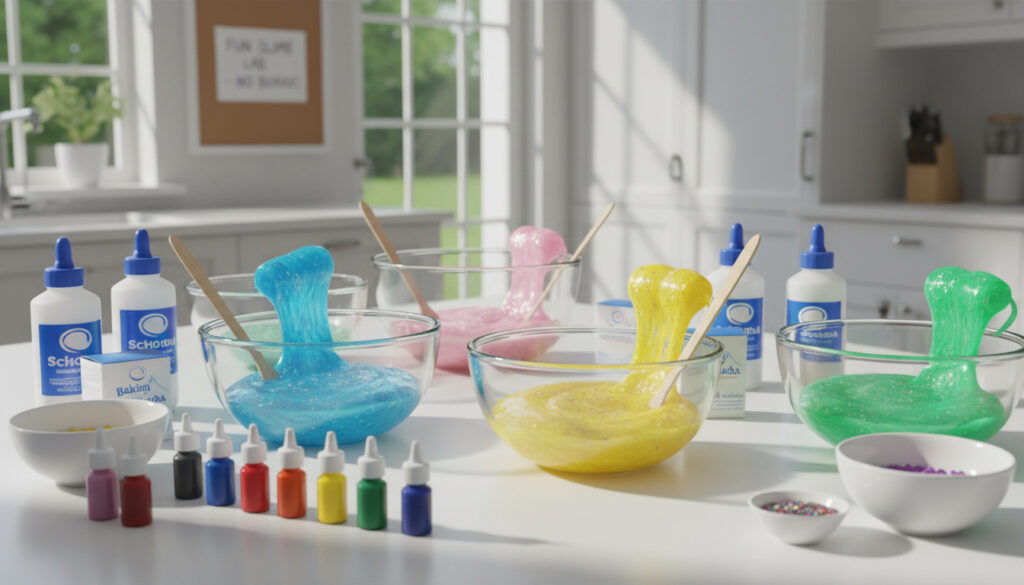
How to Make Slime Without Activator – 4 Safe Recipes
Parents and educators increasingly seek alternatives to borax and contact lens solution for homemade slime. Several household chemistry methods achieve the familiar stretchy texture using shampoo, baking soda, or toothpaste instead of traditional activators.
The shift away from sodium borate solutions addresses safety concerns while maintaining the tactile experience children crave. These approaches rely on polymerization reactions between PVA glue and common household substitutes, or protein thickening in shampoo-based formulas.
This guide examines four verified recipes that require no chemical activators, detailing exact measurements, troubleshooting techniques, and the science behind why these combinations work.
How Do You Make Slime Without Activator?
Four distinct methods eliminate the need for borax or contact lens solution. Documented recipes confirm that thick shampoo combined with salt creates a glue-free base, while toothpaste and baking soda provide alternative cross-linking agents.
- Thick 2-in-1 shampoo yields better consistency than thin clarifying varieties
- Salt thickens shampoo proteins through dehydration, not chemical reaction
- Freezing intervals help set texture without cross-linking agents
- Baking soda provides alkaline structure similar to borax but milder
- Toothpaste contains mild surfactants that react with PVA glue
- White PVA glue produces fluffier results than clear varieties
- Excess baking soda creates crumbly, drying textures
| Ingredient | Amount | Function |
|---|---|---|
| Thick Shampoo | ½ cup | Base polymer |
| Salt | 1-2 pinches | Thickening agent |
| PVA Glue | 1 cup | Polymer foundation |
| Gel Toothpaste | 1 tablespoon+ | Activator substitute |
| Baking Soda | 1 cup OR ½ tsp | Structural agent |
| Body Wash | Varies | Alternative base |
Can Baking Soda Activate Slime?
Baking soda serves as the primary substitute for borax in multiple verified recipes. When combined with shampoo or dish soap, the alkaline powder creates sufficient structure to mimic traditional slime texture without sodium borate exposure risks.
The Arm & Hammer kid-friendly method combines one cup of baking soda with one tablespoon of shampoo or dish soap. The resulting mixture matches the color of the soap used and requires no freezing or extended setting time.
What Household Items Work Best?
Beyond baking soda, several bathroom staples effectively replace commercial activators. Body wash combined with baking soda creates a glue-free option, while gel toothpaste reacts with PVA glue to form stretchy polymers.
Detergent and air freshener represent advanced substitutes tested in video demonstrations. Video analysis confirms that mixing clear glue with baking soda and lavender air freshener produces clear, stretchy results after a one-hour setting period.
For baking soda-based slime, maintain approximately a 16:1 ratio of baking soda to liquid soap. Deviations produce either soupy consistency (too little soda) or crumbly, drying textures (excess soda).
The Toothpaste Method
Gel toothpaste contains mild surfactants and thickening agents that cross-link with PVA glue molecules. Testing recommends adding one tablespoon at a time until the mixture pulls away from bowl sides. White or clear glue both work, though gloves prevent staining from colored toothpaste varieties.
How to Make Fluffy Slime Without Activator?
Fluffy slime requires introducing air pockets into the polymer structure. Traditional methods use shaving cream combined with glue, but activator-free versions substitute liquid starch or baking soda combinations to achieve similar volume.
Shaving Cream Integration
Eating Richly recommends combining one cup white PVA glue with one cup shaken shaving cream. While this recipe typically uses liquid starch as the activator alternative, the starch quantity can be reduced when combined with small amounts of baking soda, creating a hybrid activator-free formula.
Clear glue proves pricier and ultimately turns white when mixed with shaving cream, making white glue the economical choice for fluffy variations.
Clear Slime Possibilities
Achieving transparency without borax or contact solution requires specific ingredient combinations. The air freshener method using clear PVA glue, food coloring, baking soda, and lavender-scented air freshener avoids the fogging common in other recipes. Demonstrations show the mixture must sit undisturbed for one hour to maintain clarity.
Is It Safe to Make Slime Without Activator?
Eliminating borax addresses rare but documented allergic reactions and skin sensitivities associated with sodium borate. However, activator-free does not imply edible or unsupervised play.
Sensitivity and Supervision
The shampoo and salt method proves gentlest for sensitive skin, utilizing cosmetic-grade ingredients rather than industrial cleaners. University of Minnesota Extension notes that all slime, regardless of activator type, requires adult supervision and hand washing after use.
These recipes eliminate boric acid exposure risks associated with traditional borax activators, though all slime remains non-edible and requires adult supervision for children under eight.
Duration and Storage
Without preservatives found in commercial activators, these slimes typically last days rather than weeks. Arm & Hammer guidelines recommend airtight containers and kneading before each use to restore elasticity. Excessive baking soda accelerates drying, while insufficient salt leaves shampoo-based varieties too runny for extended storage.
Baking soda can dry skin with prolonged contact. Rinse hands after play and apply moisturizer if irritation occurs. Poison Control confirms baking soda alternatives reduce but do not eliminate all chemical exposure risks.
How Has Activator-Free Slime Evolved?
- 2016: Borax safety concerns emerge in pediatric literature, prompting searches for alternatives.
- 2018: Baking soda and shampoo combinations gain traction as accessible substitutes.
- 2020: Glue-free shampoo methods develop, utilizing only bathroom cabinet ingredients.
- 2023: Air freshener techniques tested for clear slime applications.
- 2025: Standardized ratios establish reliable textures across temperature variations.
Sources: DIY.org, Arm & Hammer
Which Methods Are Proven and What Remains Uncertain?
| Established Facts | Uncertain Outcomes |
|---|---|
| Baking soda firms shampoo and body wash bases | Exact shelf life without chemical preservatives |
| Toothpaste cross-links PVA glue effectively | Long-term elasticity compared to borax-activated slime |
| Salt thickens via freezing and protein interaction | Optimal air freshener brands for clarity |
| Shaving cream adds stable air volume | Detergent safety profiles for toddler skin |
| Freezing accelerates thickening without chemicals | Maximum storage temperature thresholds |
Why Does Slime Need an Activator?
Traditional slime formation relies on polymerization, where borax or contact solution creates cross-links between PVA glue’s long-chain molecules. These links transform liquid glue into stretchy, cohesive material. American Chemical Society explains that activators provide borate ions that bond polymer strands.
Activator-free methods mimic this process through alternative chemistry. Salt thickens shampoo by dehydrating protein structures rather than cross-linking polymers. Baking soda creates alkaline environments that partially mimic borate effects. Toothpaste surfactants bind with glue molecules, while shaving cream introduces physical air pockets that create fluffy texture without chemical reactions. Science Buddies confirms these substitutions achieve similar tactile properties through different molecular mechanisms.
In the spirit of Green Eggs and Ham, these recipes prove that simple household items can create surprising results when combined with basic chemistry knowledge.
Who Validates These Methods?
Borax alternatives reduce exposure to boric acid, yet all homemade slime carries ingestion and skin contact risks requiring supervision.
Which Recipe Should You Try First?
Beginners should start with the shampoo and salt method for its simplicity and minimal ingredient requirements. Those seeking classic stretchy texture should try the toothpaste and glue combination. For volume enthusiasts, the shaving cream method offers the most satisfying tactile experience, though it requires precise measurement conversions for international readers. Store all varieties in airtight containers and discard when drying or odor changes appear.
Frequently Asked Questions
Can you make slime with toothpaste?
Yes. Mix PVA glue with gel toothpaste one tablespoon at a time until the mixture pulls from bowl sides. Add more toothpaste if sticky, more glue if thick.
How long does slime without activator last?
Typically 2-5 days when stored in airtight containers. Knead before each use to restore elasticity. Discard when drying or odor changes occur.
Can you make slime with just shampoo?
Yes, combined with 1-2 pinches of salt. Thick 2-in-1 shampoo works best. Freeze 10 minutes, stir, and refreeze 5-10 minutes if needed.
How do you fix runny slime without activator?
Add more salt, toothpaste, or baking soda depending on your recipe. For shampoo slime, refreeze 5-10 minutes. Sprinkle baking soda gradually for immediate thickening.
Is borax-free slime safe for toddlers?
Safer regarding chemical exposure, but not edible. Supervise children under eight. Avoid detergent methods for toddlers due to surfactant sensitivity. Rinse hands after play.
Why does my slime keep breaking?
Insufficient binding agent. Add more toothpaste to glue mixtures or more baking soda to soap bases. Knead thoroughly to distribute ingredients evenly.
Can I use baking powder instead of baking soda?
Unverified. Baking soda (sodium bicarbonate) provides the alkaline reaction needed. Baking powder contains additional acids that may prevent proper thickening.
More related posts
 What Does Chicken Pox Look Like – Pictures Stages and Signs
 Slimming World Changes 2026 – Swips, New Healthy Extras & More
 Emma Mackey – Biography, Movies & Personal Life
 Current Account Switch Offers – Best UK Bonuses Up to £500
 Johannes Radebe – Biography, Strictly Career and 2027 Tour
 Denise Lewis – Olympic Gold, Family, and UK Athletics Role
 Garden Table and Chairs – 2025 Buying Guide for UK Gardens
 CCL Share Price UK – What UK Investors Need to Know
