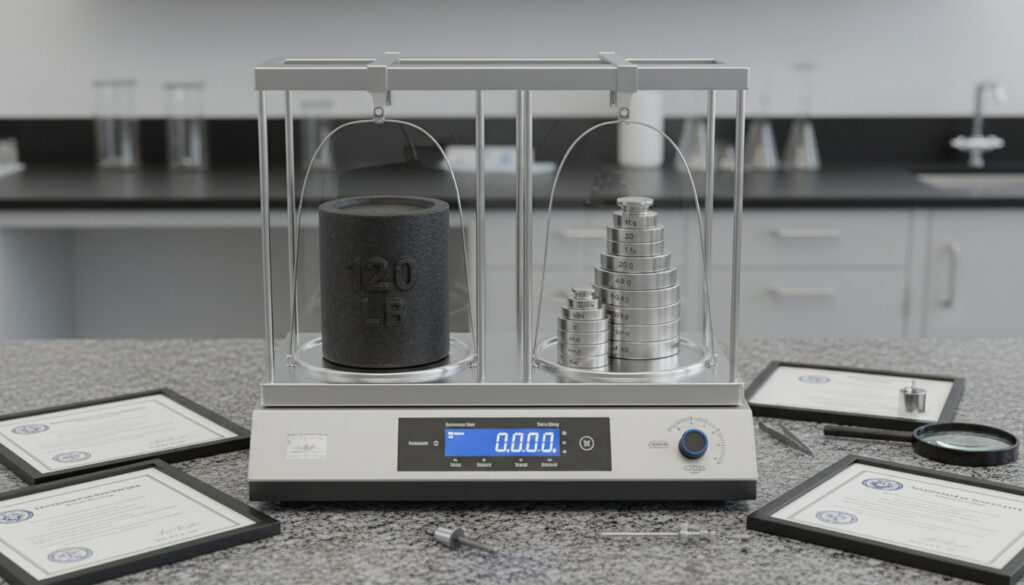
120 lbs to kg – Exact NIST Conversion (54.43 kg)
One hundred twenty pounds equals exactly 54.4310844 kilograms under the international avoirdupois standard. This conversion relies on the precise factor established by the National Institute of Standards and Technology (NIST), where one pound is defined as exactly 0.45359237 kilograms. Whether tracking body weight for fitness goals or calculating shipping loads for international freight, the distinction between rounded approximations and exact values matters significantly.
The metric equivalent of 120 pounds appears frequently in medical records, athletic training logs, and customs documentation. While rough mental math might suggest 54 kilograms, that approximation introduces an error of nearly half a kilogram—enough to affect competition weight classes or dimensional weight shipping charges. Understanding the full precision prevents costly miscalculations across contexts that range from clinical nutrition to cargo logistics.
Measurement conversion extends beyond mass alone. Similar precision applies when converting 1/4 Cup in mL for culinary recipes or interpreting other metric standards.
What Is 120 lbs in kg?
54.43 kg (rounded to two decimals)
120 × 0.45359237
54 kg (not recommended for precision)
1 lb = 0.45359237 kg
Key Conversion Insights
- The exact calculation yields 54.4310844 kilograms without rounding
- NIST defines the conversion factor as an exact, unrounded constant
- Common applications include fitness tracking, medical weighing, and international shipping
- Using 54 kg instead of 54.43 kg creates a 0.43 kilogram discrepancy
- 120 pounds converts to approximately 8.57 stone in the British system
- The metric tonne equivalent equals 0.0544310844 tons
- Conversion tables list 110 lb at 49.8952 kg and 130 lb at 58.967 kg for reference
Conversion Values Table
| Unit | Value for 120 lbs | Precision Level |
|---|---|---|
| Kilograms (kg) | 54.4310844 | Exact (NIST) |
| Kilograms (kg) | 54.43 | General use (2 decimals) |
| Grams (g) | 54,431.0844 | Exact |
| Ounces (oz) | 1,920 | Exact (16 oz per lb) |
| Stone (st) | 8.5714285714 | Exact |
| US Ton | 0.06 | Standard |
| Metric Tonne (t) | 0.0544310844 | Exact |
| 110 lb equivalent | 49.8952 kg | Reference point |
| 130 lb equivalent | 58.967 kg | Reference point |
How to Convert Pounds to Kilograms (Formula)
The conversion from pounds to kilograms follows a straightforward multiplication using the international avoirdupois definition. The standard mandates that one pound equals exactly 0.45359237 kilograms, a value fixed by NIST for scientific and commercial uniformity.
The Standard Calculation Method
To convert any value from pounds to kilograms, multiply the pound value by 0.45359237. For 120 pounds, the calculation runs: 120 × 0.45359237 = 54.4310844 kg. NIST documentation confirms this factor represents an exact definition rather than an approximation, ensuring consistency between imperial and metric systems.
Reverse Conversion Calculations
Converting from kilograms back to pounds requires division by the same factor or multiplication by its reciprocal. The inverse formula states: pounds = kilograms ÷ 0.45359237, alternatively expressed as kilograms × 2.2046226218. Applying this to 120 kilograms yields 264.554714622 pounds, demonstrating the asymmetry between the two scales.
Always perform calculations using the full NIST factor before rounding. Computing with truncated values like 0.4536 or 0.454 introduces systematic errors that compound in commercial or scientific applications.
Exact and Rounded 120 lbs to kg Conversion
Different contexts demand varying levels of numerical precision. While the exact value extends to seven decimal places, practical usage typically requires only two or four decimal places depending on the industry standard.
Precision Gradations
The exact mathematical result of 54.4310844 kilograms serves as the baseline. For general conversation and non-critical applications, rounding to 54.43 kg provides sufficient accuracy. Mathematical references confirm this two-decimal standard for common purposes. More precise contexts such as laboratory weighing or athletic competition may utilize 54.4311 kg (four decimal places) to minimize cumulative rounding errors.
When Rough Approximations Fail
Rounding 120 pounds to exactly 54 kilograms creates a deviation of 0.431 kilograms—nearly one pound of mass. Calculator tools warn against this rough approximation for precision work. In shipping, this discrepancy affects dimensional weight pricing; in medicine, it alters dosage calculations for weight-dependent medications.
Dividing 120 by 2.2 instead of 2.2046226218 yields 54.545 kilograms, introducing an error of 0.114 kg. Similarly, using the approximate factor 0.454 produces 54.48 kg, offset by 0.05 kg from the exact value.
Errors frequently occur when users confuse length units (kilometers) with mass units (kilograms) or apply the conversion to non-avoirdupois pound definitions such as troy pounds used in precious metals.
Practical Applications and Conversion Pitfalls
The 120-pound threshold appears across diverse professional domains, each imposing specific accuracy requirements. Understanding where precision proves essential—and where common errors emerge—prevents operational failures.
Fitness and Medical Weighing
Digital scales in clinical and athletic environments should display four to six decimal places for meaningful tracking. A 0.43 kilogram variation represents nearly one pound of body mass, significant for athletes monitoring competition weight classes or patients tracking fluid retention. Conversion tables recommend high precision for these sensitive measurements.
International Shipping Compliance
Freight forwarders and customs brokers must apply the exact NIST conversion factor for international documentation. The metric tonne equivalent of 0.0544310844 tons determines cargo classifications and tariff calculations. Using rounded values risks non-compliance with international shipping standards or miscalculated shipping charges based on dimensional weight formulas.
Systematic Error Patterns
Four primary mistakes recur in pound-to-kilogram conversions: substituting 0.454 for the precise factor, dividing by 2.2 rather than multiplying by 0.45359237, confusing mass with length units, and rounding intermediate results before final calculation. Technical documentation emphasizes computing full precision first, then rounding only the final result to match the original measurement’s significant digits.
Conversion Accuracy
Established Information
- One avoirdupois pound equals exactly 0.45359237 kilograms by NIST definition
- 120 pounds converts to exactly 54.4310844 kilograms
- The conversion factor is mathematically exact with no tolerance range
- NIST tables mark pound-to-kilogram conversions as exact (underlined) without uncertainty
- Imperial tons (long tons) differ from US tons; 120 lb equals 0.0535714286 long tons
Precision Variables
- Industry-specific rounding conventions vary between 2, 4, or 6 decimal places
- Colloquial use of “pound” may ambiguously refer to mass or force (pound-force)
- Troy pounds (used for precious metals) differ from avoirdupois pounds; the conversion factor applies only to avoirdupois
- Historical pound definitions (pre-1959 US pound or imperial pound) varied slightly before international standardization
Pounds vs Kilograms Context
The pound remains a unit of mass in the US customary system, while the kilogram serves as the base mass unit in the International System of Units (SI). The kilogram derives its definition from fundamental physical constants, whereas the pound derives from the international avoirdupois agreement standardized in 1959.
Global commerce and science increasingly rely on metric measurements, yet the pound persists in everyday American usage for body weight, produce, and postal items. Converting between these systems requires more than mental math for applications ranging from pharmaceutical dosing to athletic competition. NIST Handbook 44 establishes the legal metrology governing these conversions in commercial applications.
Beyond mass conversions, similar precision standards apply across measurement domains. Converting 1/4 Cup in mL for culinary applications or interpreting metric specifications in manufacturing requires equally rigorous attention to exact factors versus approximations.
Official Sources
Authority for the 120 lbs to kg conversion derives from national measurement institutes and international treaties.
“The conversion factor 1 lb = 0.45359237 kg is an exact value for precise scientific and engineering use without rounding errors. This factor ensures consistency between imperial (avoirdupois pound) and metric systems.”
NIST Special Publication 811, Appendix B
“Conversions are exact (underlined in NIST tables), preserving original measurement precision without loss.”
NIST Handbook 44, Appendix C
Current NIST publications maintain this exact standard without deviation, ensuring that 120 pounds will always convert to precisely 54.4310844 kilograms in legal and scientific contexts.
Related Conversions
Understanding 120 pounds in metric context opens pathways to related weight calculations. One hundred pounds converts to 45.3592 kilograms, while 150 pounds yields 68.0389 kilograms—useful brackets for comparing body weight ranges or cargo loads. For currency exchange calculations in international transactions, see 50 Euros in Pounds as a complementary conversion reference.
Frequently Asked Questions
Is 120 pounds exactly 54 kg?
No. While 54 kg serves as a rough approximation, the exact conversion equals 54.4310844 kg. Using 54 kg introduces an error of approximately 0.43 kg, or nearly one pound.
What is the formula for converting 120 lbs to kg?
Multiply 120 by 0.45359237. The calculation 120 × 0.45359237 equals exactly 54.4310844 kilograms.
How many grams is 120 pounds?
120 pounds equals exactly 54,431.0844 grams, derived by multiplying the kilogram value by 1,000.
Why do some calculators show 54.43 kg and others 54.4311 kg?
Different rounding conventions apply. Two decimal places (54.43 kg) suit general use, while four decimal places (54.4311 kg) serve precision contexts like fitness tracking.
Can I divide by 2.2 to convert 120 lbs to kg?
Dividing by 2.2 yields 54.545 kg, which contains an error of 0.114 kg. For accuracy, divide by 2.2046226218 or multiply by 0.45359237.
What is 120 pounds in stone and kilograms?
120 pounds equals exactly 8.5714285714 stone, or 8 stone and 8 pounds. In kilograms, this equals 54.4310844 kg.
Is 120 pounds overweight?
Whether 120 pounds constitutes overweight depends entirely on height, body composition, and demographic factors. At 54.43 kg, this weight falls within normal ranges for many adult heights but requires individual medical assessment.
More related posts
 Ada Wong – Complete Character Profile and Cosplay Tips
 Amusement Parks Near Me – Best UK Theme Parks and Family Guide 2025
 Madera at Treehouse London – Menu, Reviews and Location Guide
 Andy Murray Next Match – Retired After 2024 Olympics
 Weston Super Mare Beach – Guide to Tides, Access and Activities
 Steve Gerrard – Biography, Net Worth and 2025 Status
 Another Word for Good – 200+ Synonyms for Every Context
 Aj Shabeel – Biography, Age, Family and Career Facts
